CompTIA DataX is the premier certification for highly experienced professionals seeking to validate competency in the rapidly evolving field of data science. DataX equips you with the skills to precisely and confidently demonstrate expertise in handling complex data sets, implementing data-driven solutions, and driving business growth through insightful data interpretation.
Skills Learned
Apply mathematical and statistical methods appropriately, including data processing, cleaning, statistical modeling, linear algebra, and calculus concepts.
Utilize appropriate analysis and modeling methods to make justified model recommendations for modeling, analysis, and outcomes.
Implement machine learning models and understand deep learning concepts to advance data science capabilities.
Implement data science operations and processes effectively to support organizational goals.
Demonstrate an understanding of industry trends and specialized applications of data science in various fields.
Exam Details
Exam version: V1
Exam series code: DY0-001
Launch date: July 25, 2024
Number of questions: a maximum of 90 questions
Types of questions: multiple-choice and performance-based
Duration: 165 minutes
Passing score: pass/fail only (no scaled score)
Language: English and Japanese
Recommended experience: 5+ years in data science or a similar role
Retirement: usually three years after launch (estimated 2027)
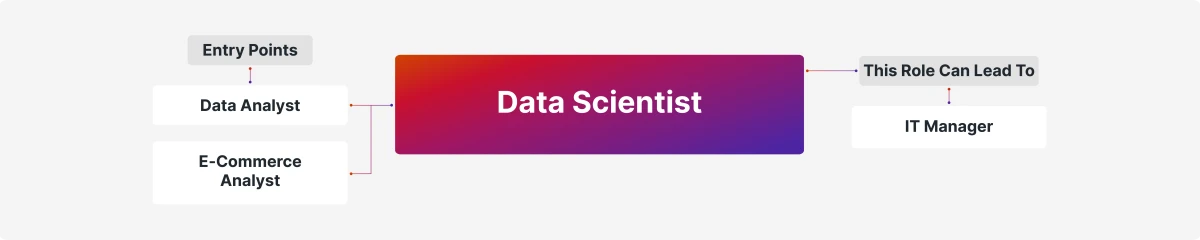
Career Path
Target Audience
Data Analyst
E-commerce Analyst
Data Scientist
IT Manager
Course Content
5 modules · 25 topics
01Mathematics and statistics (17%)4 topics
Statistical methods: applying t-tests, chi-squared tests, analysis of variance (ANOVA), hypothesis testing, regression metrics, gini index, entropy, p-value, receiver operating characteristic/area under the curve (ROC/AUC), akaike information criterion/bayesian information criterion (AIC/BIC), and confusion matrix.
Probability and modeling: explaining distributions, skewness, kurtosis, heteroskedasticity, probability density function (PDF), probability mass function (PMF), cumulative distribution function (CDF), missingness, oversampling, and stratification.
Linear algebra and calculus: understanding rank, eigenvalues, matrix operations, distance metrics, partial derivatives, chain rule, and logarithms.
Temporal models: comparing time series, survival analysis, and causal inference.
02Modeling, analysis, and outcomes (24%)5 topics
EDA methods: using exploratory data analysis (EDA) techniques like univariate and multivariate analysis, charts, graphs, and feature identification.
Data issues: analyzing sparse data, non-linearity, seasonality, granularity, and outliers.
Data enrichment: applying feature engineering, scaling, geocoding, and data transformation.
Model iteration: conducting design, evaluation, selection, and validation.
Foundational concepts: applying loss functions, bias-variance tradeoff, regularization, cross-validation, ensemble models, hyperparameter tuning, and data leakage.
Supervised learning: applying linear regression, logistic regression, k-nearest neighbors (KNN), naive bayes, and association rules.
Tree-based learning: applying decision trees, random forest, boosting, and bootstrap aggregation (bagging).
Deep learning: explaining artificial neural networks (ANN), dropout, batch normalization, backpropagation, and deep-learning frameworks.
Unsupervised learning: explaining clustering, dimensionality reduction, and singular value decomposition (SVD).
04Operations and processes (22%)7 topics
Business functions: explaining compliance, key performance indicators (KPIs), and requirements gathering.
Data types: explaining generated, synthetic, and public data.
Data ingestion: understanding pipelines, streaming, batching, and data lineage.
Data wrangling: implementing cleaning, merging, imputation, and ground truth labeling.
Data science life cycle: applying workflow models, version control, clean code, and unit tests.
DevOps and MLOps: explaining continuous integration/continuous deployment (CI/CD), model deployment, container orchestration, and performance monitoring.
Deployment environments: comparing containerization, cloud, hybrid, edge, and on-premises deployment.
05Specialized applications of data science (13%)4 topics
Optimization: comparing constrained and unconstrained optimization.
NLP concepts: explaining natural language processing (NLP) techniques like tokenization, embeddings, term frequency-inverse document frequency (TF-IDF), topic modeling, and NLP applications.
Computer vision: explaining optical character recognition (OCR), object detection, tracking, and data augmentation.
Other applications: explaining graph analysis, reinforcement learning, fraud detection, anomaly detection, signal processing, and others.
Schedule Dates
4 upcoming batches
Session TypePhysical sessions run at our training facility.
DataX
Batch Dates
Duration
Batch Options
Language
Action
30 November 2026 - 04 December 2026Next
5 Days
4 hours & 8 hours
English / Arabic
08 March 2027 - 12 March 2027
5 Days
4 hours & 8 hours
English / Arabic
14 June 2027 - 18 June 2027
5 Days
4 hours & 8 hours
English / Arabic
20 September 2027 - 24 September 2027
5 Days
4 hours & 8 hours
English / Arabic
Can’t find a suitable date? Request a schedule that fits your team.
CompTIA DataX is designed to validate advanced, cross-functional data skills, including analytics, governance, integration, and strategy, bridging technical expertise with business intelligence.
How does CompTIA DataX differ from CompTIA Data+ and DataSys+?
Data+ focuses on analytics and interpretation.
DataSys+ addresses database administration and system management.
DataX takes a holistic approach, covering enterprise-wide data management, governance, strategy, and advanced analytics.
What are the prerequisites for this course?
While no mandatory prerequisites exist, learners should ideally have 3–5 years of experience in data analytics, business intelligence, or IT systems, along with familiarity with SQL, BI tools, and data governance principles.
Is the course vendor-neutral?
Yes. DataX maintains a vendor-neutral approach but references widely used platforms like AWS, Azure, Google Cloud, Power BI, and Tableau for applied examples.
How does the course address compliance and governance?
DataX emphasises global regulatory standards such as GDPR, HIPAA, ISO 27001, and CCPA, ensuring professionals can manage compliant data environments.
Does the course include AI and machine learning concepts?
Yes. While not a deep ML/AI certification, DataX introduces AI-assisted analytics, predictive modelling, and automation for data-driven decision-making.
Can DataX be a stepping stone to advanced certifications?
Yes. It provides a strong foundation for certifications such as Certified Analytics Professional (CAP), DAMA CDMP, AWS Big Data Specialty, and Microsoft Certified Data Engineer.
How We Deliver
Flexible Training Options to Meet Your Needs
Choose how you learn — live online, in-classroom, at your workplace, or internationally. CounselTrain delivers certified IT training across the UAE in the format that fits your team.
Select the method that best suits your needs.
Online Instructor-Led Training
Learn from the comfort of your workplace or at home through live virtual sessions led by expert trainers.