CompTIA Data+ is an early-career data analytics certification for professionals tasked with developing and promoting data-driven business decision-making. Equip yourself with skills to better analyze and interpret data, communicate insights, and demonstrate competency. CompTIA Data+ validates that certified professionals have the skills required to facilitate data-driven business decisions.
Skills Learned
Identify basic concepts of data schemas and dimensions, and understand the differences between common data structures and file formats to build a strong foundation in data concepts and environments.
Apply data acquisition, cleansing, profiling, and manipulation techniques to enhance data mining skills.
Use appropriate descriptive statistical methods and summarize types of analysis and critical analysis techniques for effective data analysis.
Translate business requirements into meaningful visualizations by creating reports or dashboards.
Summarize key data governance concepts and apply data quality control techniques to ensure accuracy and compliance.
Exam Details
Exam version: V1
Exam series code: DA0-001
Launch date: February 28, 2022
Number of questions: a maximum of 90 questions
Types of questions: multiple-choice and performance-based
Duration: 90 minutes
Passing score: 675 (on a scale of 100-900)
Languages: English, Japanese, and Thai
Recommended experience: 18–24 months in a report or business analyst job role, with exposure to databases and analytical tools, a basic understanding of statistics, and data visualization experience
Retirement: usually three years after launch (estimated 2025)
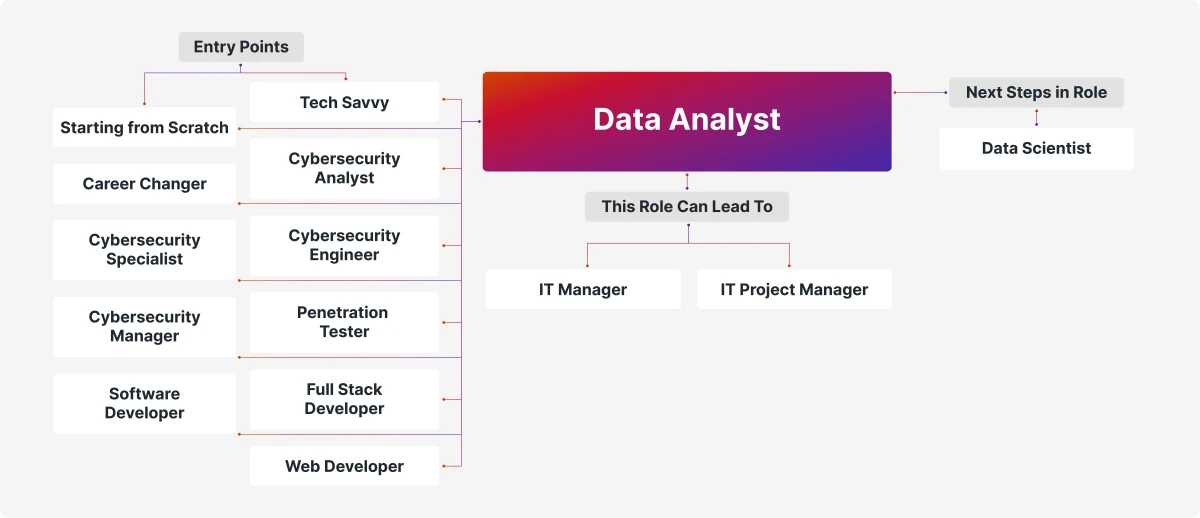
Career Path
Target Audience
Data Analysts
Database Administrators
Data Engineers
Business Analyst
Entry-level Data Scientists
Systems Analysts
IT Managers
Data Consultants
Course Content
5 modules · 18 topics
01Data concepts and environments (15%)3 topics
Data schemas and dimensions: identifying databases, data marts, data warehouses, data lakes, and slowly changing dimensions.
Data types: comparing date, numeric, alphanumeric, currency, text, discrete vs. continuous, categorical/dimension, images, audio, and video.
Data structures and file formats: comparing structured and unstructured data and file formats like text/flat files, JavaScript object notation (JSON), extensible markup language (XML), and hypertext markup language (HTML).
02Data mining (25%)4 topics
Data acquisition: explaining integration methods like delta load, extract/load/transform (ELT), and collection methods like web scraping, application programming interfaces (APIs), surveys, sampling, and observation.
Data cleansing and profiling: identifying duplicate data, missing values, invalid data, outliers, specification mismatches, and data type validation.
Data manipulation techniques: executing techniques like merging, blending, concatenation, appending, imputation, aggregation, transposing, normalizing, and parsing.
Query optimization: explaining filtering, sorting, date functions, logical functions, aggregate functions, indexing, temporary tables, and execution plans.
03Data analysis (23%)3 topics
Descriptive statistics: applying measures of central tendency, dispersion, frequencies, percentages, percent change, and confidence intervals.
Analysis techniques: summarizing trend analysis, performance analysis, exploratory analysis, and link analysis.
04Visualization (23%)5 topics
Business requirements: translating requirements into reports using measures of central tendency, dispersion, and percentages.
Report and dashboard design: using cover pages, design elements, and documentation.
Dashboard development: applying considerations for development processes and delivery.
Visualization types: applying line charts, pie charts, scatter plots, bar charts, histograms, heat maps, geographic maps, tree maps, stacked charts, and word clouds.
Report types: comparing static vs. dynamic, ad-hoc, self-service, recurring, and tactical research reports.
05Data governance, quality, and controls (14%)3 topics
Data governance: summarizing access, security, storage, use, entity relationships, classification, jurisdiction, and breach reporting.
Data quality control: applying validation methods, quality dimensions, rules, metrics, and automated checks.
Master data management (MDM): explaining processes and circumstances for MDM.
Schedule Dates
4 upcoming batches
Session TypePhysical sessions run at our training facility.
CompTIA Data+
Batch Dates
Duration
Batch Options
Language
Action
07 December 2026 - 11 December 2026Next
5 Days
4 hours & 8 hours
English / Arabic
08 March 2027 - 12 March 2027
5 Days
4 hours & 8 hours
English / Arabic
14 June 2027 - 18 June 2027
5 Days
4 hours & 8 hours
English / Arabic
20 September 2027 - 24 September 2027
5 Days
4 hours & 8 hours
English / Arabic
Can’t find a suitable date? Request a schedule that fits your team.
What is the CompTIA Data+ certification course about?
The CompTIA Data+ course provides professionals with essential skills in data literacy, analysis, and interpretation, enabling them to make data-driven decisions, apply governance practices, and communicate insights effectively.
What prerequisites are recommended before enrolling?
Although no formal prerequisites are required, it is recommended that learners have 18–24 months of hands-on experience in a data-related role, along with basic knowledge of databases, statistics, and business intelligence tools.
Does the course cover both technical and business-oriented aspects of data?
Yes. Data+ strikes a balance between technical data skills (such as queries and data modelling) and business intelligence (such as presenting findings and driving decision-making).
What career advantages does earning Data+ provide?
It validates your ability to handle data confidently, positioning you for roles such as Data Analyst, Business Intelligence Analyst, Reporting Analyst, or Data Governance Specialist.
Does the course prepare me for advanced data certifications?
Yes. Data+ can serve as a foundation for advanced certifications such as Microsoft Data Analyst Associate, Google Data Analytics Professional, or even more specialised paths like Certified Analytics Professional (CAP).
Does the course cover data storytelling and communication skills?
Yes. The curriculum includes modules on presenting insights effectively to both technical and non-technical audiences, an essential skill for influencing business decisions.
How We Deliver
Flexible Training Options to Meet Your Needs
Choose how you learn — live online, in-classroom, at your workplace, or internationally. CounselTrain delivers certified IT training across the UAE in the format that fits your team.
Select the method that best suits your needs.
Online Instructor-Led Training
Learn from the comfort of your workplace or at home through live virtual sessions led by expert trainers.