CompTIA DataSys+ is a certification designed for professionals with 2–3 years of experience in database administration. It validates the skills needed to deploy, manage, and secure data systems while ensuring business continuity and compliance with industry standards. This vendor-neutral certification equips you with the knowledge to build, support, and maintain databases, implement security best practices, and manage data assets effectively in today’s growing and complex data environments.
Skills Learned
Understand database structure types and develop, modify, and run SQL code to gather, store, and manage data assets across various operating systems.
Plan and design databases, implement and test systems, and optimize data deployment processes for effective database deployment.
Monitor and report on database performance, perform maintenance tasks and create critical documentation to support database management and maintenance.
Secure databases, protect against attacks, manage authorization, and ensure governance and regulatory compliance to enhance data and database security.
Prepare for and recover from incidents by implementing disaster recovery, backup, and restoration best practices for database management systems.
Exam Details
Exam version: V1
Exam series code: DS0-001
Launch date: July 18, 2023
Number of questions: maximum of 90 questions, including multiple-choice and performance-based questions
Duration: 90 minutes
Passing score: 700 (on a scale of 100–900)
Languages: English and Japanese
Recommended experience: no prerequisites, with 2–3 years of experience in a database administrator role recommended
NICE and DOD 8140 work roles: database administrator
Retirement: Usually three years after launch (estimated 2026)
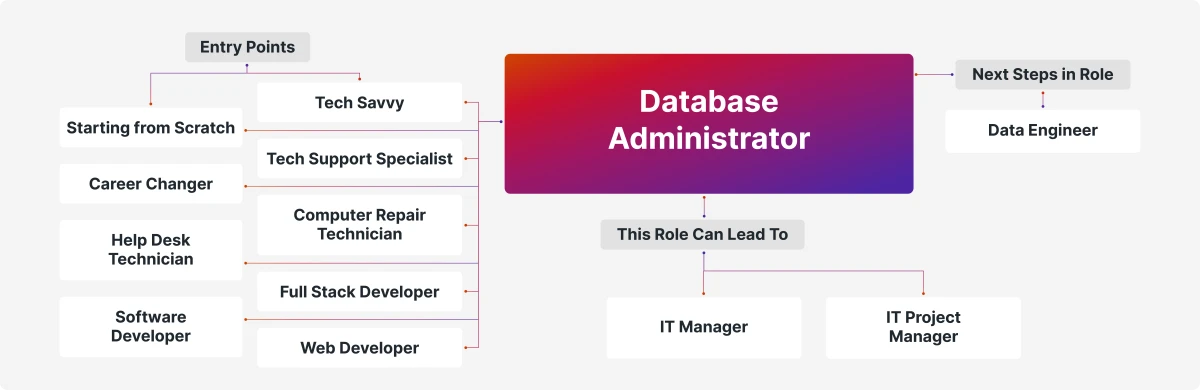
Career Path
Target Audience
Software Developer
Web Developer
Database Administrator
Data Engineer
IT Manager
IT Project Manager
Course Content
5 modules · 19 topics
01Database fundamentals (24%)4 topics
Database structure types: comparing relational and non-relational databases like NoSQL, DynamoDB, and MongoDB.
SQL code development: applying data definition language (DDL), data manipulation language (DML), transaction control language (TCL), ACID (atomicity, consistency, isolation, durability) principles, stored procedures, and views.
Scripting methods: comparing server-side vs. client-side scripting and using languages like Python, PowerShell, and command-line scripting.
Programming impact: using object-relational mapping (ORM) tools like Hibernate and Entity Framework, validating SQL code, and analyzing database server impact.
02Database deployment (16%)3 topics
Planning and design: gathering requirements, designing database architecture, and creating documentation like data dictionaries and entity relationship diagrams (ERDs).
Implementation and testing: validating schemas, performing stress tests, managing version control, and testing database connectivity.
Deployment phases: installing, configuring, provisioning, and validating scalability.
03Database management and maintenance (25%)4 topics
Monitoring and reporting: tracking system alerts, performance metrics, transaction logs, and resource utilization.
Documentation and tools: using data dictionaries, ERDs, standard operating procedures (SOPs), and compliance documentation.
Data management tasks: modifying data, managing redundancy, defining relationships, and using views/materialized views.
04Data and database security (23%)5 topics
Data security concepts: applying encryption (in transit, at rest), data masking, and destruction techniques.
Governance and compliance: implementing data loss prevention, retention policies, and regulations like the General Data Protection Regulation (GDPR) and Payment Card Industry Data Security Standard (PCI DSS).
Authentication and authorization: managing access controls, password policies, and identity management.
Infrastructure security: applying physical controls like biometrics and fire suppression, and logical controls like firewalls and port security.
Threat mitigation: addressing SQL injection, denial of service (DoS), phishing, ransomware, and brute-force attacks.
05Business continuity (12%)3 topics
Backup and recovery: creating disaster recovery plans, replication strategies, and failover processes.
High availability: implementing clustering, load balancing, and system redundancy.
Risk assessment: conducting impact analysis, risk mitigation, and continuity testing.
Schedule Dates
4 upcoming batches
Session TypePhysical sessions run at our training facility.
DataSys+
Batch Dates
Duration
Batch Options
Language
Action
26 October 2026 - 30 October 2026Next
5 Days
4 hours & 8 hours
English / Arabic
01 February 2027 - 05 February 2027
5 Days
4 hours & 8 hours
English / Arabic
03 May 2027 - 07 May 2027
5 Days
4 hours & 8 hours
English / Arabic
09 August 2027 - 13 August 2027
5 Days
4 hours & 8 hours
English / Arabic
Can’t find a suitable date? Request a schedule that fits your team.
This course validates the knowledge and skills required to manage, secure, and support databases, focusing on data administration, governance, performance tuning, and disaster recovery.
What are the prerequisites for this course?
Although no formal prerequisites exist, learners are recommended to have 2–3 years of hands-on experience in database or system administration. Familiarity with SQL, cloud environments, and basic networking is beneficial.
Which database platforms are addressed in the training?
The course takes a vendor-neutral approach but covers common systems such as Microsoft SQL Server, MySQL, Oracle Database, PostgreSQL, and cloud-based databases.
Is data security and compliance part of the course?
Yes. Modules include database access control, encryption, auditing, GDPR/ISO compliance, and implementing best practices for regulatory standards.
How relevant is the course for cloud database environments?
The course addresses both on-premises and cloud-based solutions, including hybrid models, database-as-a-service (DBaaS), and migration strategies.
How does this course support career advancement?
Completing DataSys+ validates advanced database administration skills, opening opportunities for roles like Database Administrator, Systems Engineer, Data Systems Analyst, and Cloud Database Specialist.
Is automation or scripting part of the training?
Yes. Automation practices, scripting, and Infrastructure as Code (IaC) are introduced to improve database efficiency and reduce manual overhead.
What industries benefit most from DataSys+ professionals?
Industries that rely heavily on robust data infrastructures such as banking, healthcare, telecom, government, logistics, and e-commerce highly value this certification.
How We Deliver
Flexible Training Options to Meet Your Needs
Choose how you learn — live online, in-classroom, at your workplace, or internationally. CounselTrain delivers certified IT training across the UAE in the format that fits your team.
Select the method that best suits your needs.
Online Instructor-Led Training
Learn from the comfort of your workplace or at home through live virtual sessions led by expert trainers.